 |
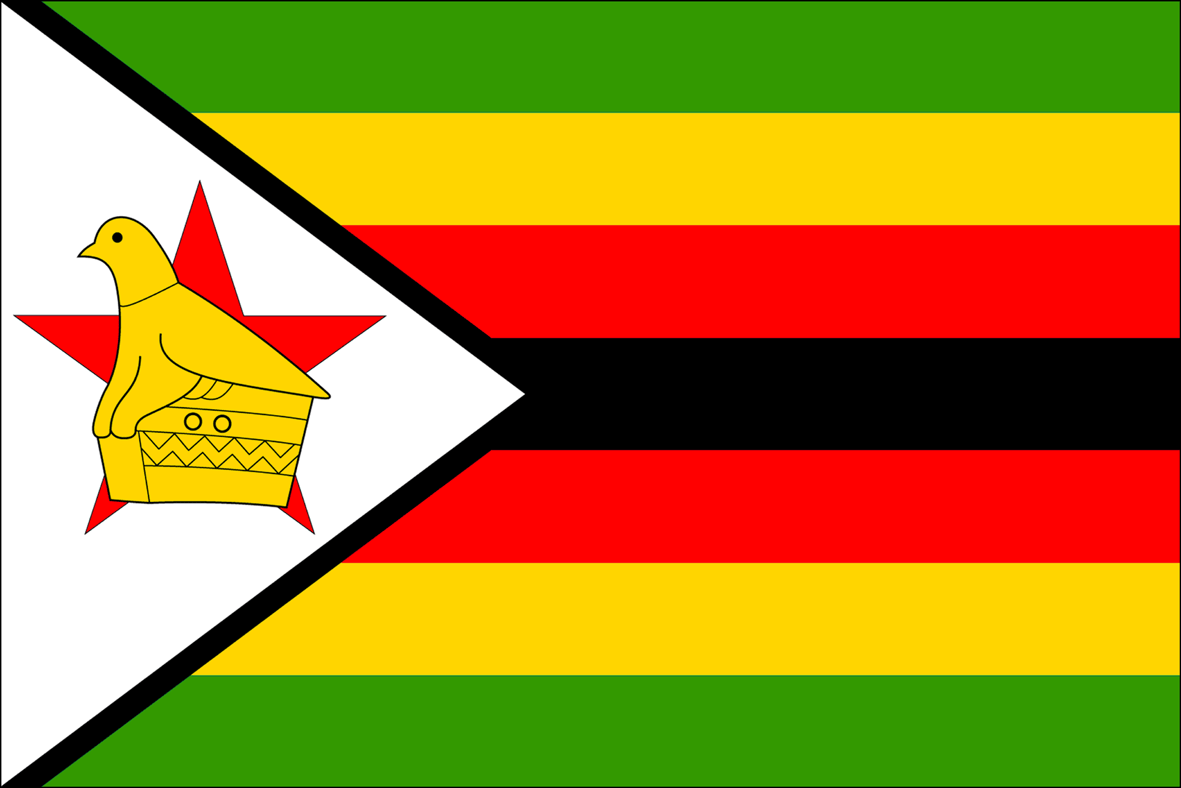
| After over 3 decades, Mugabe still enjoys the Zimbabwean Presidency |
At the end of the 2013 elections, which, surprisingly, were free of any violence of note, Robert Mugabe and his ZANU-PF party have, once again, come through in a resounding victory over their opposition in Morgan Tsvangirai and the MDC. Right from the beginning, Tsvangirai branded the elections as "a sham", accusing the ZANU-PF party of rigging the poll results and of taking advantage of voting irregularities in urban areas (where MDC support is greatest), an allegation which has been made in the last few elections in Zimbabwe. Roy Bennett, an MDC politician and white land-owner who has been imprisoned and tortured at the hands of Mugabe's leadership, has called out for a "political boycott" as well. It seems preposterous that a man approaching his 90s will be ruling over a country, but for now Zimbabwe will not see a change in its leadership.
| Urban areas like the capital, Harare (also where most of the employed educated populace is based), are where MDC support is greatest (hmm, wonder if there is a connection....) It is alleged that there was the unwarranted disenfranchisement, on ridiculous grounds, of over a million people in the urban areas who ended up being uncounted for, which ultimately meant that the MDC were probably denied a chance at winning the election. Since then, Tsvangirai and the MDC have made the matter know to outside bodies such as the SADC. |
Regardless of the MDC's appeal, what's done is done, unfortunately. So what does this mean for Zimbabwe? We all know about the economic and social disaster of the mid-to-late 2000s; the massive unemployment (of up to near 95%) and the hyperinflation of the now-defunct Zimbabwean dollar (which, in 2008, was an unfathomable 89,700,000,000,000,000,000,000%). At one stage, the national public account held only $217. We all saw the lack of food on shelves, cholera outbreaks, and the massive exodus of Zimbabweans to neighboring South Africa. All of this a result of Mugabe's land reform policy implemented in the late-90s. Land was redistributed by race, with white landowners being evicted (and brutally assaulted for not complying), and with the land being handed over the black Zimbabweans. Boss Robert seems to think otherwise. After being interviewed by CNN's Amanpour, he seemed to make the claim that the economic situation in his country was entirely down to "[unwarranted] US sanctions".
| Yes,a 1 trillion dollar actually manifested under Mugabe's leadership |
 |
| White farmers (who, in actuality, formed the basis of this once strong economy are now subject to evictions and brutality on a regular basis |
 |
| A supermarket in Harare in 2008- Where's the food? |
 |
| This is a home for more than half of Zimbabwe's population |
 |
| Food is still hard to come by for most children in the country |
For a country once deemed as the "bread basket of Africa", Zimbabwe will once again have to contend with more of the same, if not a potential exacerbation, of its problems from before. It is disheartening to see a country fall from grace the way Zimbabwe has. Mugabe's rule has been nothing short of a dictatorship, in which not only whites, but dissidents as well (supporters and members of the MDC party), are subjected to torture and life endangerment. Mugabe is living proof of power going to a politician's head. From being the hero and fighter for independence for blacks in the country, to a man focused wholly on maintaining power based on propaganda and intimidation, Mugabe has, inadvertently, integrated the leadership styles of tyrannical, totalitarian single-party leaders. From once being comparable to Martin Luther King, Kwame Nkrumah and Nelson Mandela, in a handful of decades, he's now comparable to the likes of Saddam Hussain, Kim Jong-Il and Pol Pot. In fact, his system is somewhat reminiscent of a slightly-less brutal equivalent of Hitler's system, sans the concentration camps and gas chambers, of course. I mean, Hitler epitomized fascism with a hatred of the Jewish race and a desire to eradicate the German population of them. Mugabe, having been witness to the subjugation of blacks in Rhodesia, developed a clear animosity towards whites in general, making the claim even in the late 1970s that if in power, "land would be divided by race". The forced eviction of white landowners does bring to mind elements of fascism., much like how Jews forcibly lost their business and the land they owned during the days of the Weimar Republic. Mugabe's political ideology is supposedly in the center of the spectrum, but for me, in actuality, what we are seeing is no different than an extreme-right-wing leadership. This, indubitably, will not change in any way now that Mugabe and the ZANU-PF party are still in control.
 |
| Violence is the norm as a means of eliminating dissidence |
 |
| ZANU-PF "supporters" voice their support, most of whom are struggling to find out where their next meal will come from |
From my standpoint, the immediate future of Zimbabwe looks bleak and stagnant. Much like the Kim's North Korea, Castro's Cuba and Mubarak's Egypt, the already-wounded Zimbabwe looks set receive a few more heavy blows under its extended ZANU-PF leadership. Mugabe is probably under the mindset of "if it's already broken, why fix it? As long as I am in power and living the life of luxury, what else matters?" Don't be surprised to see Zimbabweans smuggling themselves out of the country to places like Zambia and Mozambique for a better life.
 |
 |
| Mugabe's luxurious mansion, while the rest of his people are living in squalor..... |
